Korean 2-Point Mahjong Ⅴ
– Standard Rules and Scoring for Beginners
Chapter 5. Winning Hand (Going Out or Mahjong Hand)
The winning hand almost consists of a pair (head) and four sets (bodies), but there is only one exception in the form, which is “Seven Pairs hand” in Korean 2-Point Mahjong. A winning hand is 14 tiles in total if without any quadruplet set.
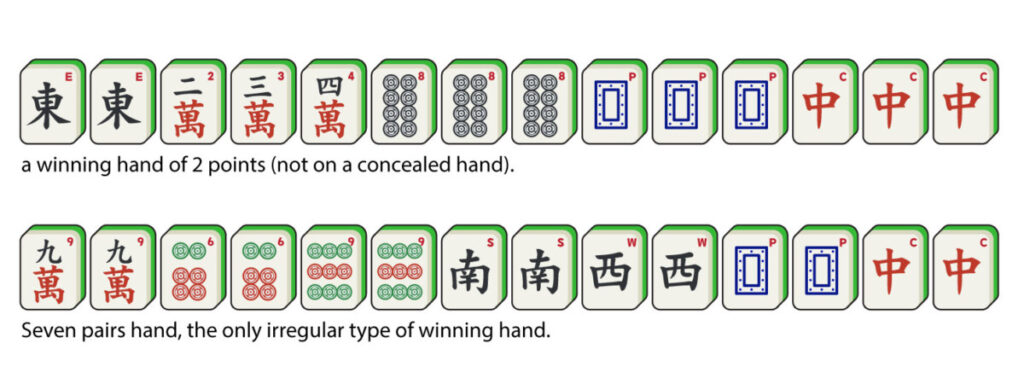
The special pattern of the winning hand determines the score (faan) of each winning hand. The special pattern of each winning hand is called “yak” in Korean.
The winning hand (yak) that is easy to make usually has low score. Of course, the harder it is to make, the higher the score to get. In Korean 2-Point Mahjong, winning hands must have 2 points (fann) at least.
For your information, a “chicken hand” is a hand tile that contains no yak or just 1 point yak (faan), and therefore it scores 0 or 1 point. Although it is the winning hand shape of “1 pair and 4 bodies”, the win with chicken hand is not allowed in Korean 2-Point Mahjong.
5.1 The Basic Type of Winning Hand
The basic type of winning hand consists of 14 tiles, 1 pair and 4 bodies, and the four sets consist of sequences, triplets, or quadruplets. In Korean 2-Point Mahjong, there are six basic types of winning hand including a special structure like seven pair hand. (Note: “1,1” = a pair, “1,2,3” = a sequence, “1,1,1” = a triplet, or a quadruplet)
➊ 11, 123, 123, 123, 123 (can get 2 points only on a Concealed Hand)
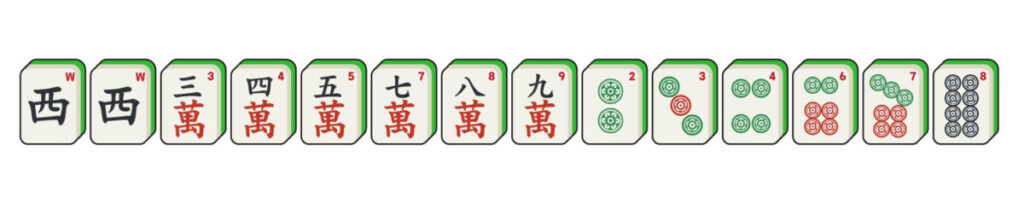
“All sequences”. West Wind, for example, cannot use a pair of west wind as the head to complete all sequences which is a kind of winning hand. Likewise East Wind cannot use a pair of east wind as the head.
➋ 11, 123, 123, 123, 111 (can get 2 points only on a Concealed Hand)
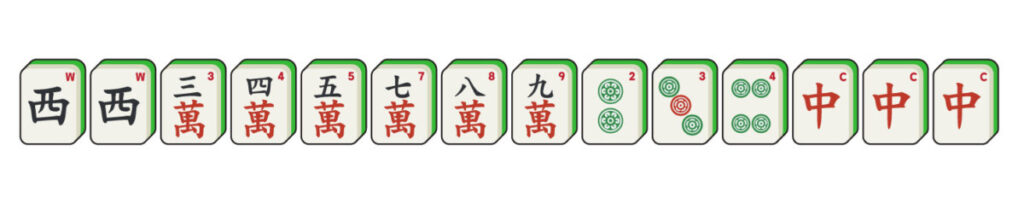
Just 1 point (a triplet of red dragon) if not on a Concealed Hand.
➌ 11, 123, 123, 111, 111 (may get 2 points even on a Meldeded Hand)
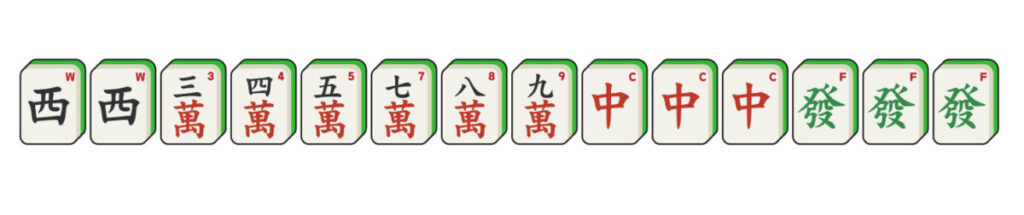
➍ 11, 123, 111, 111, 111 (get still more points on a Concealed Hand)
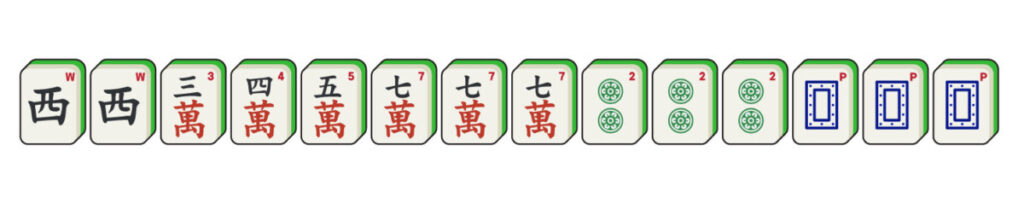
➎ 11, 111, 111, 111, 111 (get still more points on a Concealed Hand)
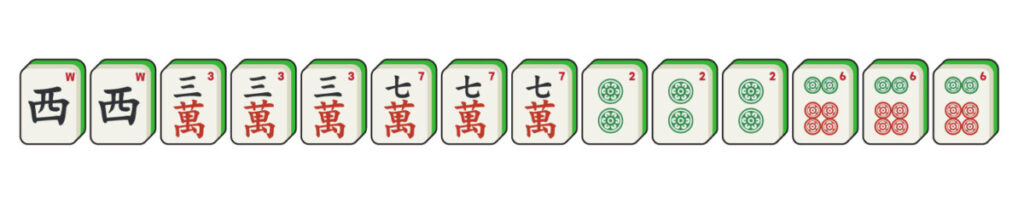
➏ 11, 11, 11, 11, 11, 11, 11 (possible only on a Concealed Hand)
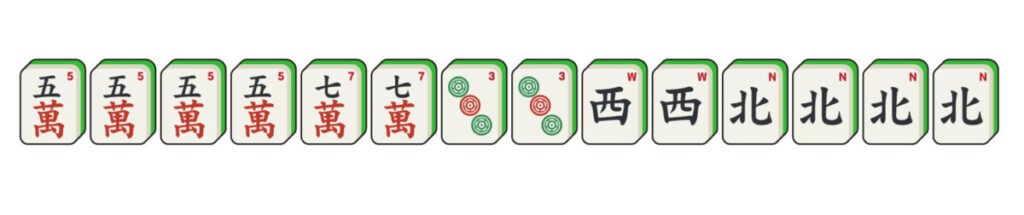
Not a meled kong, but concealed hand is allowed.
5.2 The Kind and Value of Winning Hand (Yak)
Korean mahjong has a total of 35 various winning hands, including 26 basic winning hands and 9 additional (bonus) winning hands. A winning hand is also called “yak” or “scoring elements”, and is counted its value as “point” or “faan”. (1 point = 1 faan)
There are eight categories of yak, depending on the type of combination: ① Sequence based ② Triplet based ③ Kong based ④ Honor tile based ⑤ Suit tile based ⑥ Terminal based ⑦ Seven pair based ⑧ Special cases.
The value of yak is based on the degree of difficulty to complete. In Korean 2-Point Mahjong, there are nine grades of yak: 1, 2, 4, 5, 6, 8, 12, 16 and 24 faan. More than two fan can be scored for a winning hand in Korean 2-Point Mahjong.
5.3 Two Ways to Get a Winning Hand
A ready hand usually consists of 13 tiles, a hand that is only one tile away from a winning hand. A winning hand typically consists of 14 tiles in the absence of a set of quadruplet. Therefore, players should first make a ready hand to win.
As a state of a ready hand, there are two ways to get a winning hand: “Self-Draw Win” and “Win by Discard”. The winner should clearly announce “Self-Drawn!” or “Win!” if he wins on his own, and “By Discard!” or “Mahjong” if he wins on someone else’s discarded tile. In Korean, the former is pronounced “Ola!” and the latter is “Ssoa!”.
➊ Self-Draw Win (also known as Win by Self-Drawn or Self-Drawn)
When a player completes his or her winning hand with a new tile drawn from the wall, this is called a “self-draw win”. If a player can win by self-drawn on concealed hand (1 point), the player get another 1 basic point as fully concealed hand.
“Win on kong” and “last tile draw” are essentially a self-draw win. So is “win on supplement tile”. It is a supplement tile of a kong.
➋ Win by Discard (Mahjong on a discard or Win on Discard)
When a player completes his or her winning hand with a tile discarded by another, this is called a “win by discard”. A win by discard has no points at all.
“Robbing the kong” and “last tile claim” are treated as “win by discard”. These are additional winning hand (bonus yak).
5.4 The Winner
Depending on the rules of Korean 2-Point Mahjong, only one player can win in each game. Although two or three players can declare “By Discard!” on a discarded tile at the same time, the winner is only the player on the right seat of the loser who discarded the winning tile (A loser is also called a “discarder”). However, if all players agree in advance, multiple players can win the game at the same time.
After declaring a “self-draw win!” or a “win by discard!”, the winner should show all the tiles to the three opponents. All players then double-check the winning hand together and calculate the score. The losers must not meld their hand tiles or change the order of discarded tiles on the table until everyone has checked the final score.
5.5 Score calculation and payment
There are two ways of score calculation. You must have at least 2 basic points to win. No matter how many bonus points you have, it has nothing to do with winning.
① Ante Point + Basic Points + Bonus Points = Final Points
② Basic Points + Bonus Points = Final Points.
The first one is preferred. Ante is a certain amount of point that a player has to pay before starting each game like poker games. The amount can be agreed upon in advance by the players, usually 10 points.
The payment method depends on whether it is “self-draw win” or “win by discard”. Self-draw win always scores higher than win by discard.
① Self-draw win: Every loser pays the final points to the winner. (×3)
② Win by discard: Only the discarder pays double the final point to the winner. (×2)
Assuming that the “East Wind” won a game with 5 basic points and 5 bonus points, each calculation method is as follows. (10 ante point)
① Self-draw win: 10 ante points + 5 basic points + 5 bonus points = 20 points. (East Seat +60, South –20, West –20, North –20)
② Win by discard (the “discarder” is North Wind): 10 ante points + 5 basic points + 5 bonus points = 20 points. (East Seat +40, south ±0, West ±0, North –40)