Korean 2-Point Mahjong Ⅳ
– Standard Rules and Scoring for Beginners
Chapter 4. Waiting to Win (Wait)
In mahjong, the first person who completes the set of 14 tiles wins a game. The set is composed of 1 head (pair) and 4 bodies. Four bodies are made of sequences, triplets, and quadruplets.
A “waiting to win” is the state of waiting for one tile to complete the winning hand. The number of waiting to win is exact 13 tiles when there is no quadruplet. Waiting to win is also known “ready”, “ready hand”, “wait”, “waiting”, or “calling”.
The hand tile below is a ready on concealed hand. If a player draws or claims a green dragon or red dragon, the player can win the game.

Since Korean 2-Point Mahjong requires 2 minimum point on the winning hand, the ready state of the winning hand must meet the 2 minimum point requirement. If it cannot be completed with just one tile in a way that meets this requirement, the hand tile is not considered as a ready state.

This hand tile is not a ready in Korean 2-Point Mahjong since it has no 1 point because of not on concealed hand, and even if it has a red dragon triplet, it has only one point.
4.1 Three Basic Forms of Wait
There are three basic forms of wait: “One-Sided Basic Type”, “Two-Sided Basic Type”, and “Multi-Faceted Wait”.
4.1.1 One-Sided Basic Type
There are three waits of one-sided basic type: “Single Type of Wait”, “Edge Type of Wait”, and “Closed Type of Wait”.
❶ Single Type of Wait (Single Wait)
Single type of wait is a wait type solely waiting for a tile to make “the pair” (the head). It is invalid for more than one tile as if holding “4, 5, 6, 7” and waiting on a 4 and a 7.

In the case of single wait, “the winning tile” is only three tiles of one kind. Since one tile has already been opened in the wait.
❷ Edge Type of Wait (Edge Wait)
Edge type of wait is a wait type solely waiting for a tile called “edge tile” (a 3 or a 7) to make a sequence. It is waiting for a 3 when holding “1 and 2”, or for a 7 when holding “8 and 9”. In the case of edge wait, the winning tile is only four tiles of one kind.

Edge wait is invalid for more than one tile. When it comes to the combination of an edge wait and a single wait, such as “1, 2, 3, 3”, a 3 tile is acceptable (treated as “1, 2, 3” & “3, 3”).

❸ Closed Type of Wait (Closed Wait)
Closed type of wait is a wait type solely waiting for a tile whose number is in the middle between two tiles to make a sequence. It is waiting for a 4 when holding “3, 5”, or for a 5 when holding “4, 6”. In the case of closed wait, the winning tile is only four tiles of one kind.

A closed wait is invalid for more than one tile. It is not a closed wait to be combined with other waits: The wait of “6, 8, 8, 8” is neither closed wait nor single wait. it is a “closed complex wait” because both a 6 or a 7 could be the winning tile.
The closed wait that is combined with an edge wait is valid: The wait of “6, 7, 8, 8, 9” is a closed wait because a 7 is only the winning tile to complete the hand tile (“7, 8, 9” and “6, 8”).

4.1.2 Two-Sided Wait
There are four waits of two-sided basic type: “Dual Paired Wait”, “Open Wait”, “Closed Complex Wait”, and “Double Pair Wait”.
❶ Dual Paired Wait
Dual paired wait is a wait type composed of 3 bodies and 2 pairs. Among the two pairs, the pair that draws or claims the winning tile becomes a body and the rest automatically becomes the head.

In the case of dual paired wait, there are only four tiles of two kinds of the winning tile, not eight tiles of two kinds. Since four tiles of two kinds have already been opened in the wait.
❷ Open Wait (Two-Sided Sequence Wait)
When the winning tile needs to complete a sequence with a two-sided wait (with the two tiles of consecutive numbers, such as “3, 4” and “6, 7” in the middle, one side faces the number 1, the other side faces the number 9), the wait type is called a open wait. It is waiting for a 2 or a 5 when holding “3, 4” and for a 5 or a 8 when holding “6, 7”.

In the case of open wait, there are up to eight tiles of two kinds of the winning tile. As we have seen, open wait is the most likely to win out of the five basic types. A open wait is also called “two faceted wait” or “two gate wait”.
❸ Closed Complex Wait
Closed complex wait is a wait type that is combined a single wait and a closed wait. It shows as a triplet and a tile, which is apart two in number.
When holding “4, 4, 4, 6”, the winning tile is a 5 (treated as “4, 4” & “4, 5, 6”) or a 6 (treated as “4, 4, 4” & “6, 6”).
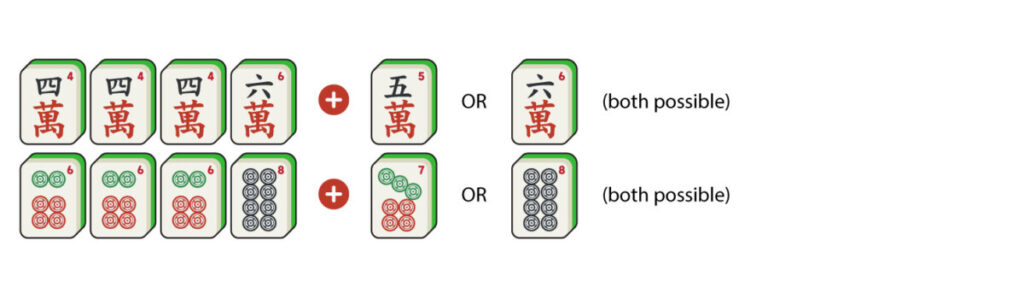
In the case of closed complex wait, the winning tile is up to seven tiles of two kinds. Since one tile has already been opened in the wait.
❹ Double Pair Wait
Double pair wait is a wait type that is combined two single waits as four consecutive numbered tiles. With this type, it is looking to pair one of the two tiles for the win. When holding “5, 6, 7, 8”, it is waiting for a 5 and a 8.

In the case of double pair wait, the winning tile is up to six tiles of two kinds. Since two tiles have already been opened in the wait.
4.1.3 Multi-Faceted Wait
Multi-faceted wait means a wait type more than a three-sided wait. There are many wait types of multi-faceted waits.