Korean 2-Point Mahjong Ⅱ
– Standard Rules and Scoring for Beginners
Chapter 2. The Goal of Korean 2-Point Mahjong
The goal of Korean 2-Point Mahjong is to “go out” (win) with completing 2-point “hand” at least. The Hands, pronounced “yak” in Korean, refer to the same hands such as “3 of kind”, “straight”, and “flush” etc. in poker games.
The term “hand” is also used to refer to all tiles owned by a player at the game table. The “hand” has another meaning, which also means a game.
A Complete Game (A Session)
There are four rounds (China) or two rounds (Japan) in a complete game of Mahjong. A round always consists of four hands (games). Korean 2-Point Mahjong does not apply the round system, but mainly uses a part-time system that sets a certain amount of time in advance and plays only at that time.
2.1 How to Make a Winning Hand
In mahjong, the basic type of winning hand consists of a pair of two identical tiles, and four sets of “triplet” or “sequence” composed with three tiles. This means that the player who combines a pair and four sets the fastest wins the game.
The winning hand is also called “going out” or “(going) mahjong”. Each complete hand usually consists of 14 tiles. Flower tiles are not included in this number. In special cases, a set can be composed of four tiles, in which case the total number of tiles can be 15.
2.1.1 The Pair (also known as The Head or The Eye)
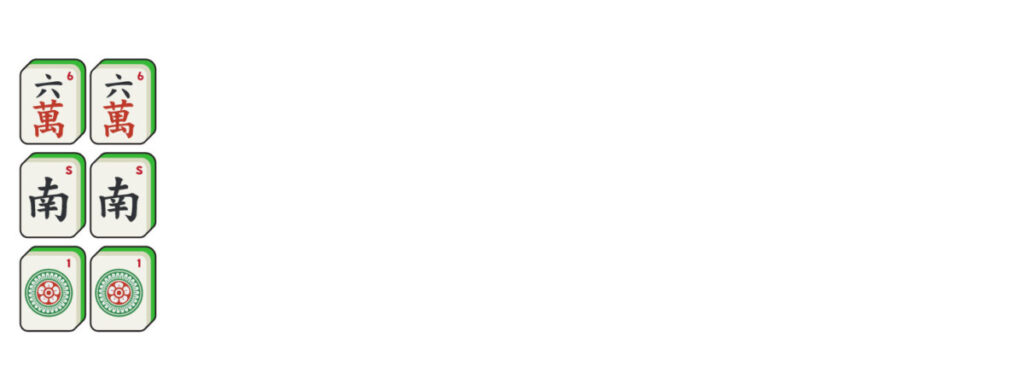
The pair is a set composed of two identical tiles.
2.1.2 Sets (also known as The Body)
There are three forms of the set: “Sequence”, “Triplet”, and “Quadruplet” (“Kong”).
(1) Sequences (also known as Chows)
A sequence is a set composed of three sequential suit tiles in the same suit. The sequence can be described as “short straight” compared to “straight” in poker game.

A sequence is also known as a “chow”. A Chow means the same as a sequence when it is a noun, but it’s also used as a verb when you declare “chow!” and bring someone else’s discarded tile to make a sequence. When used as a verb, chow is used to mean the same as the verb “chi!”.
Unlike Chinese and Japanese mahjongs, Korean 2-Point Mahjong has a special rule that players cannot do chow (chi) which can make a sequence. In Chinese and Japanese mahjongs, to chow is to take a tile thrown away by other player on the left and make a sequence. Therefore, in Korean 2-Point Mahjong, all sequences are “pure chows” only composed of the tiles from “the wall”.
The Wall & A Self-Pick
Before the game begins, 4 players turn all 104 tiles face down and mix them. Each player takes 26 tiles (4 x 26 = 104) and places in 2 layers of 13 rows (13 stacks. 13 long and 2 high tiles) in front of the player. Then 4 players push their tiles forward to create a square shape.
We call these tiles “the wall”. Players can pick up a new tile from the wall with each turn. Picking a tile from the wall is called a “self-pick”, “self-draw” or “draw”.
On the other hand, when a player discard a tile out of his or her hand, other players can take it while declaring “Pung!”, “Kong!”, or “Going out!” under the special conditions. All of these moves are called “Claim”.
(2) Triplets (also known as Pungs)
A triplet is a set composed of three identical tiles. It is three tiles of the same number in the same suit and three tiles of the same honor.

➊ Concealed Triplets
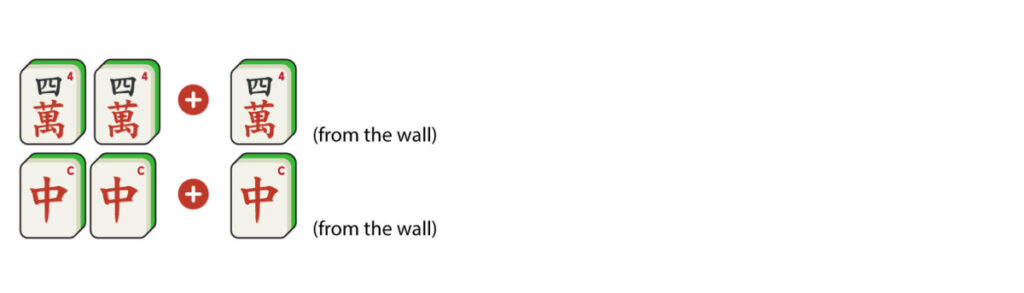
A concealed triplet is a set of three identical tiles which are all drawn from the wall. It is also called “concealed pung”, “hidden triplet” or “hidden pung”.
➋ Melded Triplets
When a player have a pair of two identical tiles, the player can complete a triplet by claiming the tile that another player has discarded. We call this a melded triplet. It is also called “melded pung” or “exposed triplet”, or “exposed pung”.

(3) Quadruplets (also known Kongs)
A quadruplet is a set of four identical tiles. There are three kinds of quadruplets: “Concealed Quadruplet”, “Small Exposed Quadruplet” and “Big Exposed Quadruplet”.
A concealed quadruplet normally scores more than a exposed quadruplet. Though a quadruplet is composed of 4 tiles, it is treated 3 tiles in number.
➊ Concealed Quadruplets
A concealed quadruplet is a set of four identical tiles which are drawn all from the wall. It is also called “concealed kong”, “hidden quadruplet” or “hidden kong”.
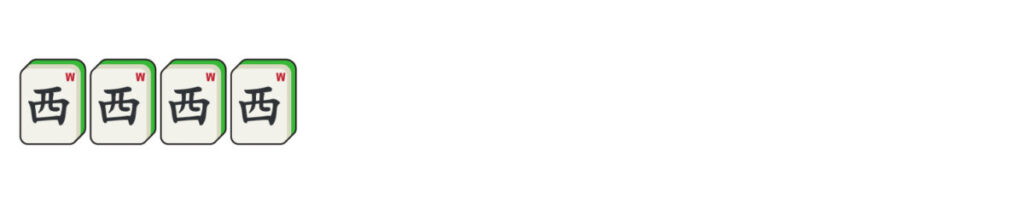
➋ Small exposed Quadruplets (also known as Small exposed Kongs)
When a player have a exposed triplet, the player can complete a quadruplet by drawing the 4th identical tile from the wall. we call this a small exposed quadruplet. It is also called “small exposed kong”, “small melded quadruplet” or “small melded kong”.

➌ Big exposed Quadruplets (also known as Big exposed Kongs)
When a player has a concealed triplet, the player can complete a quadruplet by claiming a tile that another player has discarded. we call this a big exposed quadruplet. It is also called “big exposed kong”, “big melded quadruplet” or “big melded kong”.