Korean 2-Point Mahjong Ⅲ
– Standard Rules and Scoring for Beginners
Chapter 3. Concealed Hand vs Open Hand (Claim)
Each player starts the game with 13 tiles. The 13 tiles have to be placed in front of each player by the end of the game. These 13 tiles are called “hand”.
In mahjong, the word ‘hand’ has many meanings, so to avoid confusion, in this lecture, We are going to call the “hand: which means the 13 tiles as “hand tile” in the special case. In Chinese, hand tile means a tile or tiles held in your hand.
There are two types of hand tile: “Concealed Hand”, and “Open Hand”.
3.1 Concealed Hand (1 basic score)
Concealed hand is a very important term and also known as “closed hand’ or ‘private hand”. It means all the tiles each player has are drawn from the wall without a claim.
Therefore, all sequences, triplets, and quadruplets in the concealed hand have been completed by drawing from the wall. If there’s even one melded pung or kong, the hand is no longer a concealed hand. Because it is hard to maintain the state of the concealed hand, the concealed hand is always given 1 basic score. Remember that it is a short cut to win to maintain the state of a concealed hand in Korean 2-Point Mahjong. Remember one more thing. A concealed kong is treated a concealed hand.
Concealed hand tiles score more than open hand tiles in general. Note that some winning hands are only completed in the concealed hand state.
Fully Concealed Hand (aka Concealed Self-Drawn Hand, 1 basic score)
A concealed hand is a hand tile that does not claim a single tile. If you win by drawing a fresh tile from the wall in the concealed hand state, the winning hand is said to be “Fully concealed hand”. The fully concealed hand is a hand of 1 basic point. The Hand is called “yak” in Korean and “yaku” in Japan.
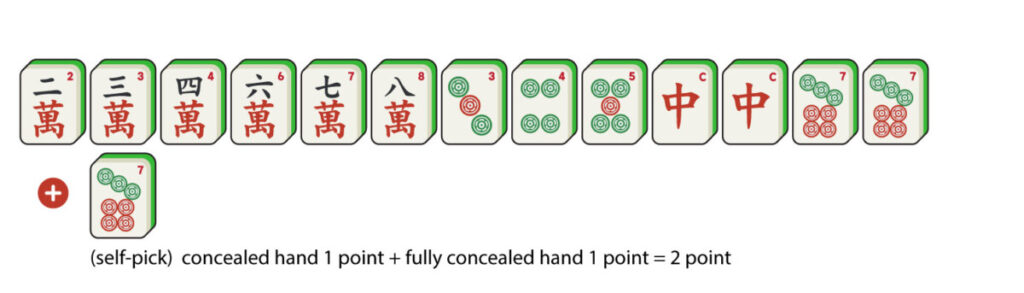
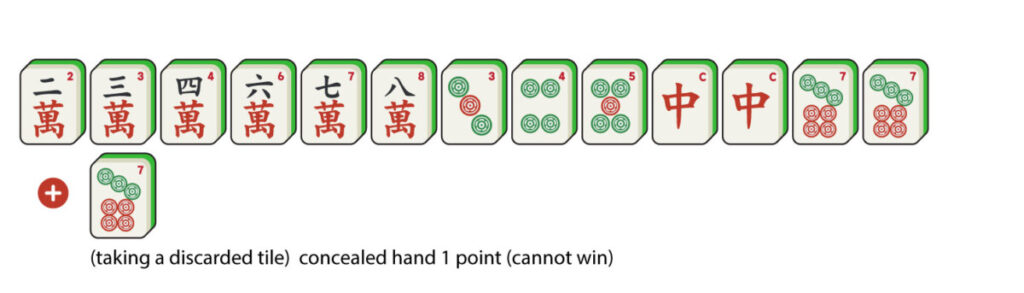
But, if you win on the discarded tile by another player in the concealed hand state, it is just a concealed hand. It has only 1 point.
3.2 Claim (Open Hand)
Everyone who plays in the game has to draw (or claim) and discard a tile in turn. As a player discards a tile, another player can claim it to go out (winning hand) or compose a set like melded triplet or melded quadruplet.
After a claim declaration, the player must display the melded set as exposed to the right of the hand tile. It is prohibited to mix the melded set into his or her concealed hand. Players cannot claim the last discarded tile except for going out.
The claim declaration must be said verbally and clearly. The most recent discarded tile can be only claimed. It is recommended that a claime should be done within a maximum of 5 seconds until the next player draws a tile from the wall. Once the next player has drawn and discarded a tile, the previous discarded tile must not be claimed no longer.
There are 2 types of claims to compose a set in Korean 2-Point Mahjong: Pung, and Kong. These will be detailed right below.
In Korean 2-Point Mahjong, a player cannot claim “Chi!” which makes a chow (a sequence) according to the rules. Perhaps this is because there is no bamboo tiles.
The Dealer and Other Seat Winds
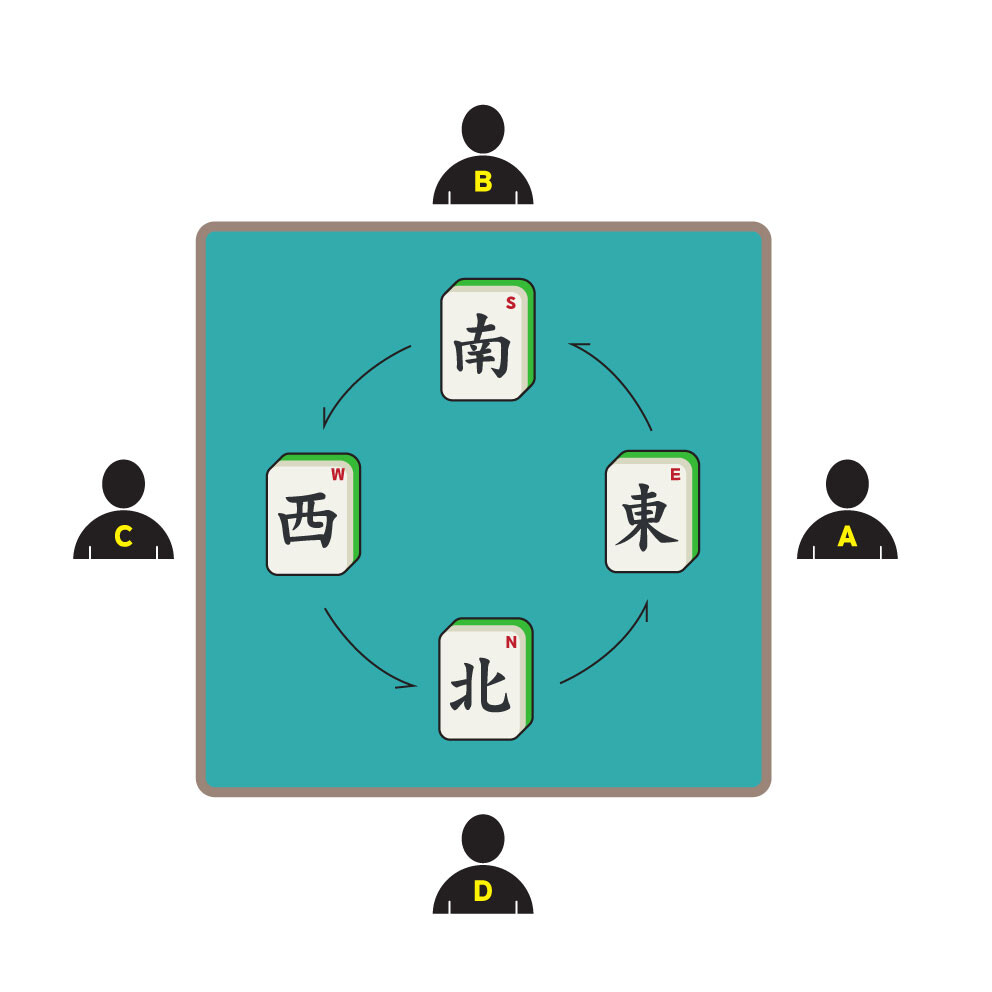
Every player has their own seat wind direction in every game: East, South, West, and North. The winds are blowing in counter-clockwise order in East, South, West, and North. The East Wind is the dealer. The other winds are called “Non-Eeat Winds”.
In the very initial game, the dealer is determined by the sum of two dice. The East plays first in the game but has no additional benefit in Korean 2-Point Mahjong.
The Claim Priority: Going out > Pung, Kong
Claiming a tile for going out (winning) takes precedence over any other claim such as pung or big exposed kong. Since there are four tiles of one kind, to pung and to kong do not never occur at the same time.
It is possible for several players want to win on the same tile at the same time. In the case, The Lower (right) Seat Wind of the player who has discarded the winning tile has the priority to the claim.
3.2.1 To Claim a Pung
Claiming a pung is to take the same tile discarded by another player, and melding them with a pair of two identical tiles from the player’s hand tiles to make a melded pung. The player has to do it after declaring “Pung!”
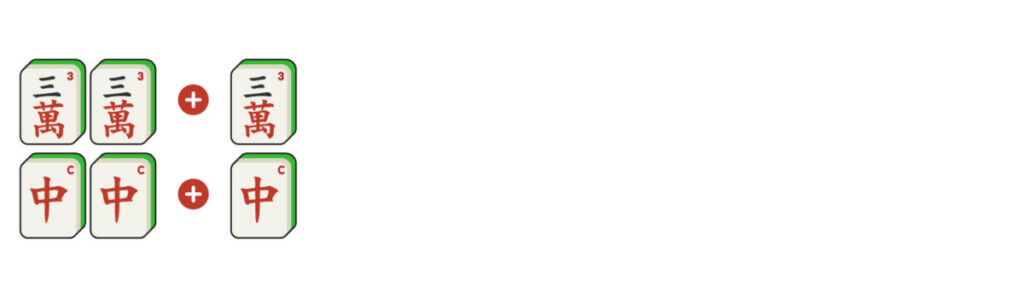
The melded pung cannot be taken into the hand tiles. It must be exposed and displayed as a set in the space between the hand tile and the wall. Melded pungs can also be placed on the right side of the hand tile. One tile of the melded pung must be rotated 90 degrees to indicate which player has discarded. Look at the picture below.
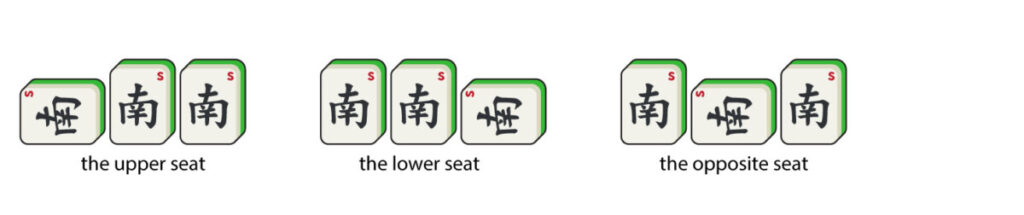
A claim of pung or kong results in some players losing their turn. It means one or two players’s turn is skipped. If the South discards a tile and the East declares a pung, the West and the North will lose their turn. Please look at the sqare above.
After claiming a pung, the player must discard a tile. Then the player’s lower (right) seat takes his or her turn and draws a tile. If the player does not want to claim the discarded tile, the player continues the turn by drawing a tile from the wall.
3.2.2 To Claim a Kong
There are 3 kinds of kong claims: “Concealed Kong”, “Small Exposed Kong”, and “Big Exposed Kong”. Concealed kongs typically scores more than melded kongs.
Even though a kong has four tiles, it is treated as a single set of three tiles like a pung. Concealed kongs are considered as concealed triplets, and melded kongs are considered as melded triplets (pungs).
Players can claim kongs twice in a row and go out on the supplement tile drawn from “the backwall” for the second kong. The backwall is the opposite side of the wall from which players usually draw tiles. It is used to draw supplement tiles for flower tiles or kongs.
Supplement Tile
After declaring a kong and displaying the kong set as exposed, the player must draw a supplement tile from the backwall not from the wall. And the player must discard a tile since drawing a supplement tile is just like a self-draw. Then the player’s lower (right) seat takes the next turn and draws a tile from the wall.
If a player wins on the supplement tile, the winning hand is called “win on kong”, which is a bonus scoring hand of 5 point. It is considered a self-drawn win. Picking up a discarded tile counts as a self-draw.
(1) To Claim a Concealed Kong
If a player possesses a concealed triplet in his or her hand and the player draws the fourth tile to complete a concealed kong or a player has four identical tiles in his or her concealed hand, the player may declare a “concealed kong!”. It’s usually declared especially when a player is looking for the win of “win on kong”.
After declairing a “concealed kong!” clearly, The player immediately exposes the four tiles to others, and then displays the tiles as a set of concealed kong in the space between the hand tile and the wall. To indicate a concealed kong, the two side tiles should be placed face down with the two middle tiles face up.
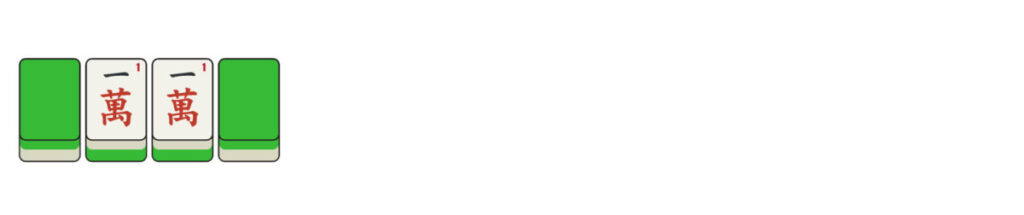
Unlike a pung or other kongs, a concealed kong may be set in front of the player with hand tile. This is because a concealed kong is treated a concealed hand tile. If a player later claims a pung or melded kong in concealed hand, the hand tile is no longer a concealed hand.
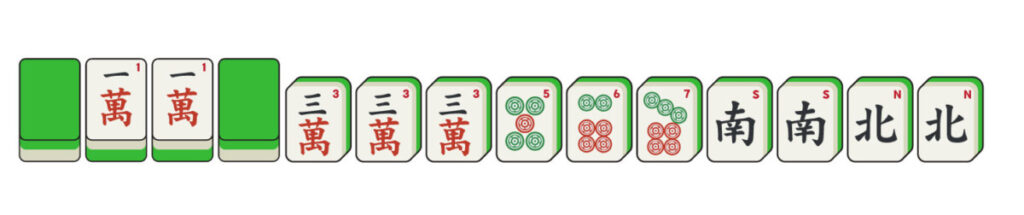
After drawing a tile from the wall or backwall on his or her own turn, a player may declare a concealed kong at the same time or next turns. But players must not declare a concealed kong immediately after claiming a pung. After drawing the supplement tile from the backwall, the player must discard a tile, if the hand is not completed.
A concealed kong cannot be made up a pung and a sequence. The 4 identical tiles only make up a concealed kong.
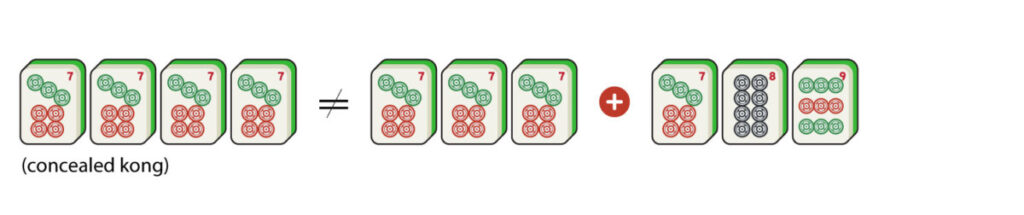
(2) To Claim a Small Exposed Kong (a Created Kong)
When a player has a exposed triplet (pung) and draws the 4th identical tile on his or her own from the wall, the pung can be extended into “a small exposed kong”. However, if an opponent discards the tile that matches one’s exposed pung, he cannot convert the pung into small exposed kong. Small exposed kongs are also called “extended kongs”, “promoted kongs”, or “created kongs”.
The player may declare “a small exposed kong!” just after drawing 4th tile or any time at next turns. Please note that a small exposed kong declaration sometimes can be missed even experts as well.
After announcing “a small exposed kong!”, the player reveals the 4th tile and adds it to the exposed pung to form an exposed kong. Then the player draws a supplement tile, and discards a tile, if the hand is not completed.
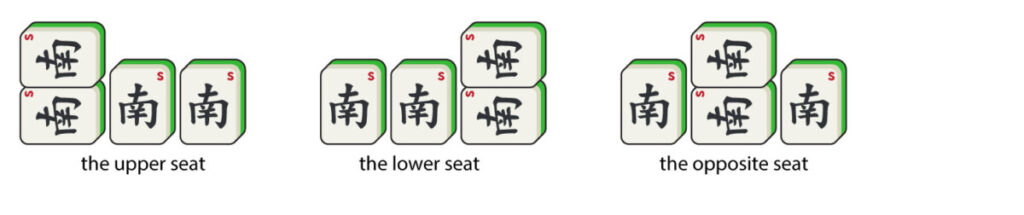
(3) To Claim a Big Exposed Kong
When a player has a concealed triplet in the hand tile and can complete a quadruplet by claiming the tile that another player has just discarded, it is called “a big exposed kong”.
The melded kong cannot be taken into the hand tiles. It must be exposed and displayed as a set in the space between the hand tile and the wall. Melded kongs can also be placed on the right side of the hand tile.
One tile of the big exposed kong must be rotated 90 degrees to indicate which player has discarded. Look at the picture below.
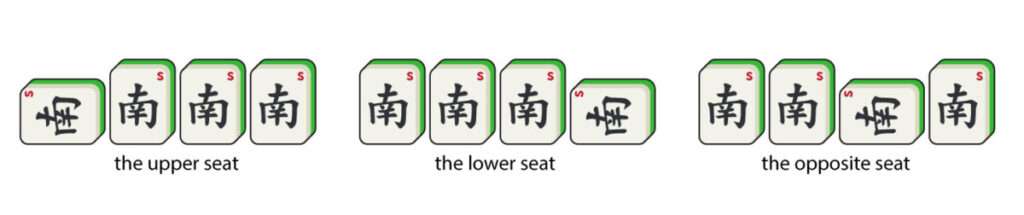
Unlike other kongs, a big exposed kong can only be claimed immediately after an opponent discarded a tile. If the next player draws a tile from the wall, the chance of declaring a big exposed kong is lost. Like other kongs, the player draws a supplement tile after declaring “big exposed kong!”, and immediately discards a tile, if the hand is not completed.