Korean 2-Point Mahjong Ⅰ
– Standard rules and Scoring for beginners
The lectures were written and edited by Park, Young Woo, the author of The Standard of Korean Mahjong (2009) and The Japanese Mahjong (2010). Both books have been sold steadily since they were published in Korea.
Characteristics of Korean 2-Point Mahjong
The rules of Korean 2-Point Mahjong have three big features compared to other countries’ mahjong rules. First, a bamboo tile which is one of suit tiles is not used at all. So, Korean 2-Point Mahjong plays with 104 tiles (including 4 flower tiles), the smallest number among the world’s mahjong versions. This means that the fewer the numbers, the shorter the time for a game and the more thrilling the game is.
Second, you cannot take the discarded tile from the player who is to your left to make a “sequence”. In other words, you cannot declare “chow!” (or “Chi!”) that can create a sequence in Korean 2-Point Mahjong.
A sequence is a combination of three consecutive numbers in the same suit such as “2, 3, 4” of Characters or “6, 7, 8” of Dots, and so on. In Korean 2-Point Mahjong, a sequence must be completed only by drawing a tile from the “wall” tiles are arranged in a row of two layers per each person.
Finally, in the official Korean version, the players need to score at least 2 basic points to declare a win. Unofficially, there are also zero-score games, which require no points for beginners, and three-score games for masters.
Chapter 1. Mahjong set
If you have a regular mahjong set, you can enjoy Korean 2-Point Mahjong games.
1. 1 The tiles (Total 104 tiles)
Korean 2-Point Mahjong is played with a set of 104 tiles, which contains 4 each of 26 different kinds of pieces. These 104 pieces can be divided into two main categories: “Suit tiles” and “Honor tiles”.
1.1.1 Suit tiles / Suits
There are two kinds of suit tiles: “Characters” and “Dots”. Each suit has 4 each of 9 different species of tiles, which are numbered from No.1 to No.9 in sequence. So a kind of suits consists of 36 pieces, and the total of suit tiles is thus 72 pieces.
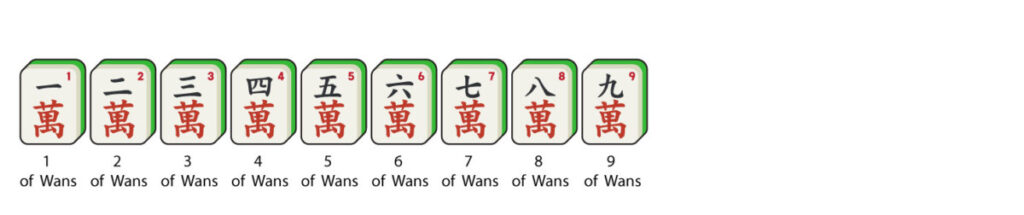
(1) Characters (also known as Wans or Craks)
The Character suit has black and red Chinese characters written in Chinese. The black letters are Chinese numbers from 1 to 9, and the red letters, which are pronounced “wan” mean there is too much wealth to count. Most mahjong sets sold in the U.S. and Europe have Arabic numerals on the character tiles for those who don’t know Chinese letters.
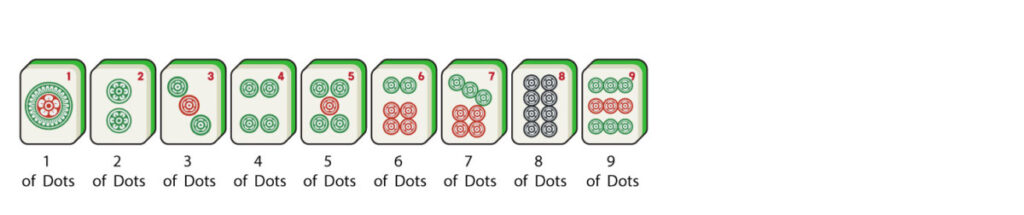
(2) Circles (also known as Balls, Pings or Dots)
The circle suit originated from the symbol needed to barter during the Middle Ages in China. It was specifically designed with medieval Chinese coins as a motif.
Special names for suits
The suits are categorized as “simples” and “terminals”. Simples are suit tiles from no.2 to no.8. They are also called “middle tiles”, “minor tiles” or “minors”. No.1 and no.9 tiles are called “terminal number tiles”, “terminal tiles” or “terminals”.
Sets composed of terminals usually score more because they are harder to make than sets composed of simples. Both terminals and honors are called “major tiles” or “majors”. In particular, “1 of wans” and “1 of dots” are also called “ace of wans” and “ace of dots” each.
1.1.2 Honor tiles / Honors
Honor tiles consist of wind tiles and dragon tiles. There are four each of four winds and three dragons of honor tiles. Thus, the total of honor tiles is 28. Most mahjong sets sold in the U.S. and Europe have English capital letters on the honor tiles respectively.
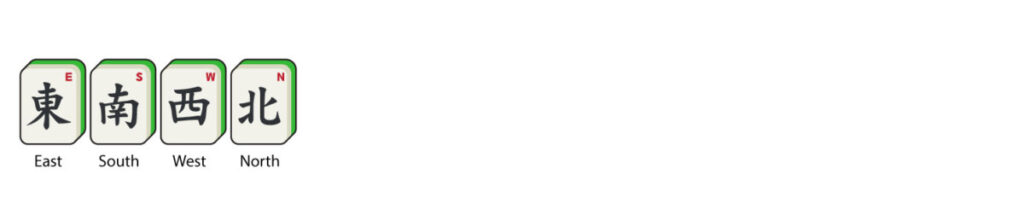
(1) Wind tiles / Winds
Wind tiles mean four directions respectively: East, South, West, North. The order of winds is counterclockwise east-south-west-north.
(2) Dragon tiles / Dragons
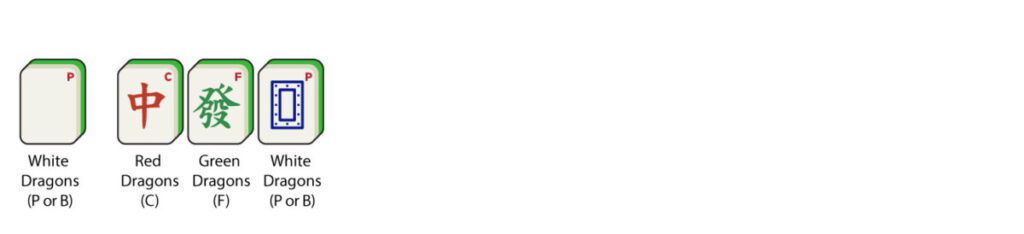
There are three cardinal tiles: “Red Dragons”, “Green Dragons”, “White Dragons”. Red dragons symbolizing human mean the “center”, and green dragons symbolizing the earth mean the “flourishing manifestation”.
The image of white dragon tiles differ slightly from each mahjong set. It usually has a black or blue frame around an empty center. Also there is a blank white dragon, which is made in Korea or Japan. White dragons, which is identified with black dragons, mean “white plank” or “white tile”.
1.1.3 Flower tiles / Flowers
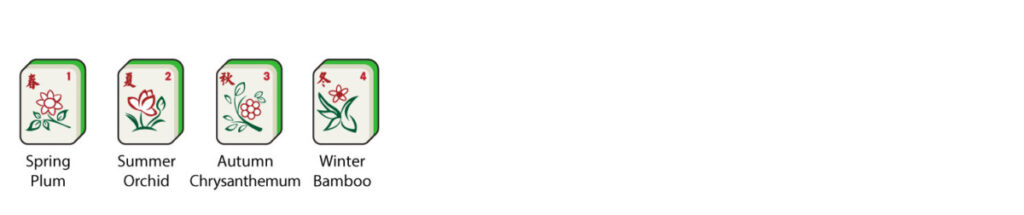
In addition to the suits and honors, there is a set of flowers which consists of four tiles. Flowers cannot be used to make a combination unlike other regular tiles. They are used as bonus tiles only. Flower tiles can get 1 point of bonus score per one tile, not the basic score. Flower tiles are marked 1, 2, 3, and 4 respectively.
1.2 Other supplies
In addition to mahjong tiles, Korean 2-Point Mahjong game requires a tables, four chairs, a pair of dice, scoring sticks, a countdown clock, and a dealer sign, etc. The table size is approximately 80 x 80 x 75 ㎝ (Width x Depth x Height).
There are four types of scoring sticks: 1 point, 3 points, 5 points, and 8 points. If there are no scoring sticks, they can be replaced with chips or baduk stones.